
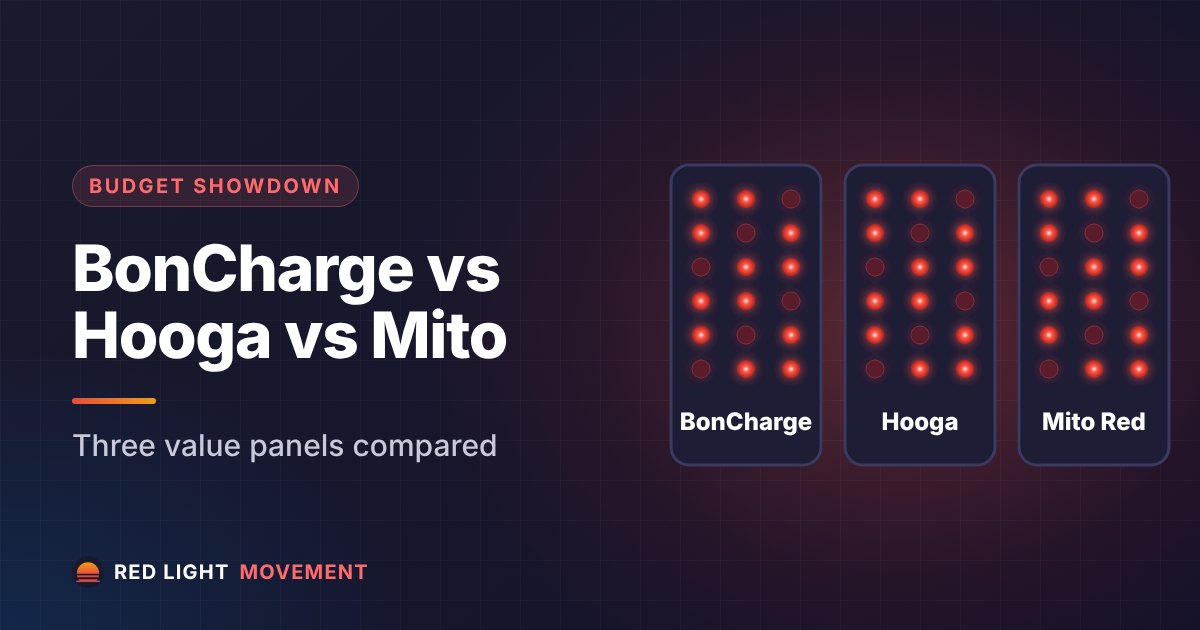
BonCharge vs Hooga vs Mito Red — if you've been shopping for a red light therapy panel without spending Joovv money, these are the three brands that keep showing up in every comparison guide and Reddit thread. All three target the under-$800 segment with panels that use clinically validated wavelengths and claim competitive irradiance. But the differences between them — in build quality, wavelength options, pricing strategy, and overall value — are real and worth understanding before you commit several hundred dollars.
This comparison breaks down the full-body flagship panels from each brand side by side. We'll cover irradiance and dosing efficiency, wavelength options, build quality and design, warranty and customer support, pricing, and ultimately who should buy which brand. This is an affiliate review — we earn commissions through some of the links below — but our analysis is independent, and we'll tell you where each brand wins and loses.
If you want deeper dives on individual brands, see our full Hooga review and Mito Red review. For context on how these brands compare to premium options like Joovv and PlatinumLED, our best red light panels pillar page covers the full market.
Table of Contents
The Three Brands at a Glance
Before we get into the specs, it helps to understand where each brand positions itself in the market — because their philosophies are meaningfully different despite overlapping on price.
BonCharge
BonCharge started as a blue-light blocking glasses brand (formerly called BLUblox) and expanded into red light therapy as part of a broader wellness ecosystem. Their product line includes red light panels, blue-light blocking glasses, EMF protection products, and sleep optimization tools. BonCharge's red light panels — including the Infrared Light Therapy Max and Half Max — use standard 660nm and 850nm wavelengths with some models incorporating 830nm. They position themselves as a science-informed wellness brand rather than a pure red light therapy specialist. Panels are priced in the $500–$700 range for full-body options.
Hooga
Hooga is a direct-to-consumer red light therapy brand that has built its reputation on one simple proposition: maximum therapeutic output per dollar. The Hooga HGPro 1500 flagship panel delivers approximately 140–150 mW/cm² at 6 inches and now lists at $1,199 after a 2026 price increase. Hooga doesn't try to be a lifestyle brand — they make panels, wraps, and targeted devices with straightforward designs and physical controls. No app, no ecosystem, just photons. See our full Hooga review for the deep dive.
Mito Red Light
Mito Red Light occupies the mid-range between budget and premium. Their MitoPRO series is the direct competitor to Hooga's HGPro line, while the MitoADAPT series offers multi-wavelength configurations (including 630nm, 660nm, 810nm, 830nm, and 850nm) that you won't find from Hooga or BonCharge. Mito Red full-body panels have been priced around $700–$900 — now at or below Hooga's full-size panels, and well below Joovv territory. Build quality and polish are a half-step above Hooga. See our full Mito Red review for details.
Irradiance & Dosing Efficiency
Irradiance — the power density of light hitting your skin, measured in mW/cm² — is the single most important specification for a red light therapy panel. Higher irradiance means faster dosing, shorter sessions, and more efficient treatment. Research consistently shows effective photobiomodulation requires approximately 20–60 J/cm² delivered to target tissue, depending on the condition (Hamblin, 2017, AIMS Biophysics). The faster your panel delivers that dose, the less time you spend standing in front of it every day.
Here's how the three brands' flagship full-body panels compare on irradiance:
Irradiance Comparison (Full-Body Panels at 6 inches)
- Hooga HGPro 1500: ~140–150 mW/cm² (third-party verified)
- Mito Red MitoPRO 1500: ~120–140 mW/cm² (third-party verified)
- BonCharge Max: ~100–130 mW/cm² (limited independent verification)
On raw irradiance, Hooga leads. The HGPro 1500 has been measured by multiple independent reviewers using calibrated solar power meters, consistently landing in the 130–160 mW/cm² range at 6 inches — closely matching Hooga's published claims. At 140 mW/cm², reaching a 40 J/cm² therapeutic dose takes approximately 4.5–5 minutes per treatment zone.
Mito Red's MitoPRO 1500 comes in slightly behind at 120–140 mW/cm², which is still strong. The difference translates to roughly 30–60 seconds of additional treatment time per zone — noticeable over months of daily use but not dramatic. Mito Red's irradiance claims have also been generally confirmed by independent testing.
BonCharge's panels have less independent verification data available. Published specs suggest irradiance in the 100–130 mW/cm² range for their full-body panels, but we've seen fewer third-party measurement reports compared to Hooga and Mito Red. This isn't necessarily a red flag — it may simply reflect BonCharge's newer presence in the red light therapy space — but it does mean we have less confidence in the exact irradiance figures.
For context, the premium benchmark is PlatinumLED's BioMax 900 at ~130 mW/cm² ($899) and Joovv's Duo 3.0 at ~100 mW/cm² ($2,399). All three budget/mid-range brands deliver irradiance that meets or exceeds these premium competitors per dollar spent.
Wavelength Options: Standard vs Multi-Spectrum
The wavelengths your panel emits determine which tissues absorb the light and which biological pathways are activated. The two wavelengths with the strongest clinical evidence for photobiomodulation are 660nm (visible red, absorbed primarily by skin and superficial tissue) and 850nm (near-infrared, penetrates deeper into muscle, joint, and bone tissue).
All three brands offer this standard 660nm/850nm pairing. Where they differ is in additional wavelength options:
Hooga: 660nm + 850nm only. Every Hooga panel uses dual-chip LEDs emitting these two wavelengths, with toggle modes for red-only, NIR-only, or combined. Hooga has chosen to specialize in the two wavelengths with the strongest evidence base rather than expanding into multi-wavelength territory. This is a defensible approach — if you're optimizing for proven therapeutic benefit per dollar, focusing on 660nm and 850nm is the safest bet.
Mito Red: Standard + multi-wavelength options. Mito Red offers two product lines. The MitoPRO series uses standard 660nm/850nm like Hooga. The MitoADAPT series adds 630nm and 810nm (and in some configurations 830nm), creating a broader spectrum that may activate additional biological pathways. The research on these supplemental wavelengths is less extensive than for 660/850nm but is growing — particularly for 810nm and its potential neurological applications (Salehpour et al., 2018, Journal of Photochemistry and Photobiology B). The MitoADAPT multi-wavelength option is Mito Red's strongest differentiator in this comparison.
BonCharge: Standard + some 830nm. Some BonCharge panel models include 830nm near-infrared alongside the standard 660/850nm pair. This positions BonCharge between Hooga's focused approach and Mito Red's full multi-wavelength offering. The 830nm wavelength has clinical support, particularly for deeper tissue applications, though the evidence is less extensive than for 850nm.
Bottom line on wavelengths: For most buyers, the standard 660nm/850nm combination is sufficient and well-supported by clinical evidence. If multi-wavelength therapy interests you, Mito Red's MitoADAPT series is the strongest option in this price range. Hooga's focused approach is the most cost-efficient way to deliver the most evidence-backed wavelengths.
Build Quality & Design
At the budget and mid-range price points, none of these panels will match the fit-and-finish of a $2,000+ Joovv. That said, there are real differences in how these three brands approach build quality.
Mito Red has the best build quality of the three. The MitoPRO and MitoADAPT series use heavier-gauge housing, better thermal management (which affects LED longevity), more substantial mounting hardware, and a generally more polished appearance. The fans are quieter, the power cables are thicker, and the overall product feels like it was designed with longevity in mind. If you care about the panel lasting 5+ years of daily use and looking reasonable mounted on your wall, Mito Red's build quality justifies some of its price premium.
Hooga's build quality is functional and adequate. The HGPro 1500 uses lighter housing and more basic hardware than Mito Red. It looks and feels like a competent medical device rather than a lifestyle product. The mounting kit does the job, the fans are slightly louder than Mito Red's, and the power cable is standard. For most buyers who plan to mount the panel in a closet, garage, or bathroom, Hooga's build quality is perfectly fine. It just won't win any design awards.
BonCharge panels fall between Hooga and Mito Red on build quality. Their design leans into the wellness-brand aesthetic more than Hooga, with cleaner lines and branding that fits their broader product ecosystem. Build quality is solid — comparable to or slightly above Hooga in terms of materials and hardware. BonCharge benefits from their experience across multiple product categories, which shows in packaging and presentation quality.
All three brands include door-mount or wall-mount hardware. None offer the modular linking system that is unique to Joovv. If you want a setup where you can chain panels together, none of these brands will work — but for most single-panel users, standalone mounting is perfectly adequate. For help choosing the right panel size for your space, see our panel size guide.
EMF & Flicker Safety
EMF emissions and flicker are quality indicators that separate legitimate red light therapy panels from cheap, potentially problematic devices. Low EMF at treatment distance and minimal LED flicker indicate proper electrical engineering and driver quality.
All three brands perform reasonably well on EMF and flicker metrics:
Hooga HGPro 1500: Near-zero EMF measured at 6-inch treatment distance. Minimal flicker. These results have been confirmed by multiple independent testers and are consistent with Hooga's published claims. Hooga's EMF performance is comparable to premium panels from Joovv and PlatinumLED.
Mito Red MitoPRO series: Low EMF at treatment distance with minimal flicker. Mito Red has invested in driver quality that shows in both EMF and flicker measurements. Their performance is on par with or slightly better than Hooga's, consistent with the slightly higher price point.
BonCharge: BonCharge advertises low EMF and minimal flicker across their panel lineup. Independent verification data is less extensive than for Hooga and Mito Red, but available reports suggest acceptable performance at treatment distance. Given BonCharge's broader focus on EMF protection products, it would be inconsistent for their own panels to emit problematic levels — and we have no evidence that they do.
The more relevant EMF concern for most buyers is avoiding unbranded or ultra-cheap panels from Amazon that lack any EMF testing. All three brands in this comparison are well above that threshold. For a deeper dive, see our EMF and flicker guide.
Warranty, Trial Period & Customer Support
Post-purchase protection matters when you're spending $500–$800 on a device you'll use daily for years. Here's how the three brands compare:
Warranty & Trial Comparison
- Hooga: 3-year warranty, 60-day risk-free trial, email support
- Mito Red: 3-year warranty, 60-day risk-free trial, email + phone support
- BonCharge: 1-year standard warranty (extended options available), 30-day trial, email support
Hooga and Mito Red lead on warranty and trial terms. Both offer 3-year warranties and 60-day trial periods, which match the terms from premium brands like Joovv and PlatinumLED. The 60-day trial is particularly valuable — it gives you a full two months to evaluate whether your panel is delivering the results you expected, with the option to return for a full refund if it isn't.
BonCharge's standard 1-year warranty and 30-day trial are shorter than the competition. Extended warranty options help close the gap, but they add cost. For a budget panel purchase where long-term reliability is a fair concern, the shorter standard warranty is a notable disadvantage versus Hooga and Mito Red.
On customer support, Mito Red has the slight edge with phone support availability alongside email. Hooga and BonCharge rely primarily on email support, which reviewers generally describe as responsive within 24–48 hours. None of these brands offer the concierge-level phone support and onboarding that Joovv provides.
Pricing Comparison
Price is where the rubber meets the road in a budget comparison. Here's the landscape for comparable full-body panels from each brand, alongside premium references for context:
Full-Body Panel Pricing (2026)
- Hooga HGPro 1500: $1,199 (HG1500: $899)
- BonCharge Max: ~$600–$700
- Mito Red MitoPRO 1500: ~$799
- Mito Red MitoADAPT 1500: ~$899 (multi-wavelength)
- PlatinumLED BioMax 900: ~$899 (reference)
- Joovv Duo 3.0: ~$2,399 (reference)
Hooga's 2026 price increase reshuffled this comparison: Hooga is no longer the low-price option among the three full-body lineups, so the decision now rests more on features than on price. Here's what you're paying for at each tier:
At $899–$1,199 (Hooga): You get the highest irradiance of the three, standard 660/850nm wavelengths, a 3-year warranty, and functional (not premium) build quality. Choose Hooga if raw output matters most.
At ~$600–$700 (BonCharge): You get solid irradiance, the BonCharge wellness brand ecosystem, and a product that comes from a company focused on light and EMF science. The $50–$150 premium over Hooga buys slightly more polished packaging and the option to buy complementary BonCharge products. The shorter warranty term partially offsets this positioning.
At ~$799–$899 (Mito Red): You get better build quality, the option for multi-wavelength therapy (MitoADAPT), pulsing modes, quieter operation, and a more polished product. The $250–$350 premium over Hooga is meaningful — roughly 50% more — but the incremental improvements in build quality and wavelength flexibility are real. For buyers who plan to use their panel for 5+ years, the Mito Red investment may pay off in longevity and versatility.
All three brands represent substantially better value than Joovv's premium pricing. The question is how much incremental improvement you're willing to pay for above Hooga's baseline value. For a broader view of budget options, see our budget red light therapy guide.
Who Should Buy Which Brand
Rather than declaring a single universal winner, the right brand depends on what you prioritize. Here's our recommendation framework:
Buy Hooga If...
You want maximum therapeutic value per dollar. If your primary criterion is "deliver the most clinically-dosed red and near-infrared light for the least money," the Hooga HGPro 1500 is the clear winner. You're getting premium-tier irradiance at a budget price, backed by a warranty and trial period that match Joovv and PlatinumLED. Hooga is the Toyota Corolla of red light therapy — it's not flashy, but it reliably delivers the result you need at a price that's hard to argue with. Also consider Hooga if you're on a tight budget and want the HG1500 at $899 for even more savings.
Buy Mito Red If...
You want the best mid-range balance of quality and features. If you're willing to spend $250–$350 more than Hooga for better build quality, multi-wavelength options (MitoADAPT series), pulsing modes, and a product that feels more premium, Mito Red is our mid-range recommendation. The MitoPRO 1500 is the straightforward choice at ~$799; the MitoADAPT is worth considering if multi-wavelength therapy appeals to you. Mito Red is the Honda Accord — a step up in refinement that many buyers find worth the moderate premium.
Buy BonCharge If...
You want a red light panel from a broader wellness ecosystem. If you're already a BonCharge customer — or if you value buying blue-light blocking glasses, EMF protection products, and red light panels from a single trusted brand — BonCharge offers that integrated experience. Their panels are solid performers that fit within a curated wellness product line. If red light therapy is one component of a broader light-management strategy for you, BonCharge's holistic brand approach has appeal. Check BonCharge panels on Amazon for current pricing and availability.
Skip All Three If...
You need FDA Class II clearance for HSA/FSA reimbursement or institutional use — consider Joovv instead. You want modular panel expansion — only Joovv offers linking. You want multi-wavelength R+ spectrum — PlatinumLED's BioMax offers the broadest wavelength range. You want the absolute cheapest option — see our best panels under $200 for entry-level picks (though we generally recommend spending more for verified irradiance).
Our Verdict
In this three-way budget showdown, each brand has a defensible position:
Best overall value: Hooga HGPro 1500 ($1,199). For the majority of buyers, Hooga delivers the best red light therapy experience per dollar. The irradiance is competitive with panels costing 2–4x more, the warranty and trial terms are industry-standard, and the device simply does what it's supposed to do — deliver a therapeutic dose of 660nm and 850nm light efficiently. If you're buying your first panel and want to minimize financial risk while maximizing therapeutic output, start here.
Best mid-range pick: Mito Red MitoPRO 1500 (~$799). If you're willing to invest $250 more than Hooga for meaningfully better build quality, the option for multi-wavelength therapy (via MitoADAPT), and a more refined product, Mito Red is the smart mid-range choice. It's the brand we recommend to buyers who plan to use their panel for 5+ years and want something that feels built to last.
Best ecosystem play: BonCharge (~$600–$700). BonCharge makes the most sense for buyers who are already engaged with their broader wellness product line or who want a single brand to cover red light, blue-light blocking, and EMF protection. The panels are competent performers, though the shorter warranty and higher per-watt cost relative to Hooga prevent it from winning on pure panel value.
None of these brands is a bad choice. All three deliver verified therapeutic wavelengths, acceptable EMF performance, and substantially better value than premium alternatives. The difference between them is marginal compared to the difference between any of them and a random unbranded panel from Amazon. For the full picture of how these fit into the broader market, see our best red light therapy panels ranking and buying guide.
Frequently Asked Questions
Which is the best budget red light therapy brand: BonCharge, Hooga, or Mito Red?
For raw output, Hooga leads. The Hooga HGPro 1500 delivers approximately 140–150 mW/cm² at 6 inches — the highest irradiance of the three — though after a 2026 price increase it now lists at $1,199, and Hooga's HG1500 is $899. Mito Red offers the best mid-range balance of features, build quality, and multi-wavelength options at $700–$800. BonCharge is the best option if you prioritize a broader wellness ecosystem and want a well-rounded brand, though their panels typically carry a slight premium over Hooga for similar specs.
How does BonCharge red light therapy compare to Hooga?
BonCharge and Hooga both target budget-conscious buyers. Hooga generally offers slightly higher irradiance per dollar and a longer warranty (3 years vs. 1 year standard). BonCharge positions itself as a broader wellness brand with complementary products like blue-light blocking glasses. For buyers focused purely on red light therapy performance per dollar, Hooga typically edges out BonCharge. For buyers who value a curated wellness ecosystem, BonCharge has appeal.
Is Mito Red worth the extra cost over Hooga?
After Hooga's 2026 price increase, Mito Red's MitoPRO series is no longer clearly more expensive than comparable Hooga panels — check both brands' current prices. In return, you get better build quality, multi-wavelength options (MitoADAPT series), pulsing modes, and a more polished product. Whether the premium is worth it depends on your priorities. If maximizing dose per dollar is your goal, Hooga wins. If you want build quality and wavelength flexibility, Mito Red justifies the extra cost. See our Mito Red review and Hooga review for full details.
Do all three brands use the same wavelengths?
All three offer the standard 660nm red and 850nm near-infrared, which have the strongest clinical evidence for photobiomodulation. Mito Red's MitoADAPT series adds 630nm and 810nm for a broader spectrum. Some BonCharge models include 830nm. Hooga sticks exclusively to 660/850nm. For most users, the standard combination is sufficient. See our wavelength guide for the full breakdown.
Are any of these brands FDA cleared?
None of these three brands have obtained FDA 510(k) Class II medical device clearance. All are FDA registered as general wellness devices. Among major red light therapy brands, Joovv is the most notable to have achieved FDA Class II clearance. This distinction affects potential HSA/FSA reimbursement but does not indicate a difference in therapeutic effectiveness. See our FDA cleared red light guide for details.
Which brand has the best warranty?
Hooga and Mito Red both offer 3-year warranties with 60-day risk-free trials — matching the terms from premium brands like Joovv and PlatinumLED. BonCharge offers a 1-year standard warranty with extended options available and a 30-day trial period. On post-purchase protection alone, Hooga and Mito Red have a clear advantage.
Can I use HSA or FSA to pay for these panels?
Since none of these three brands carry FDA Class II clearance, HSA/FSA reimbursement is not guaranteed and depends on your plan administrator. Some buyers have successfully used HSA/FSA funds with a letter of medical necessity from their physician. See our HSA/FSA guide for strategies to improve your chances.
Related Articles
Hooga Red Light Review: Best Budget Panel?
An honest, independent review of Hooga's full lineup — HGPro 1500, HG1500, HGPro 300, and knee wrap.
13 min read
Mito Red Light Review: Mid-Range Champion?
Full review of Mito Red's MitoPRO 1500, MitoPRO 750, MitoMIN, and MitoADAPT series.
14 min read
Best Red Light Therapy Panels 2026
Our complete ranking of the best red light therapy panels across every budget.
15 min read