
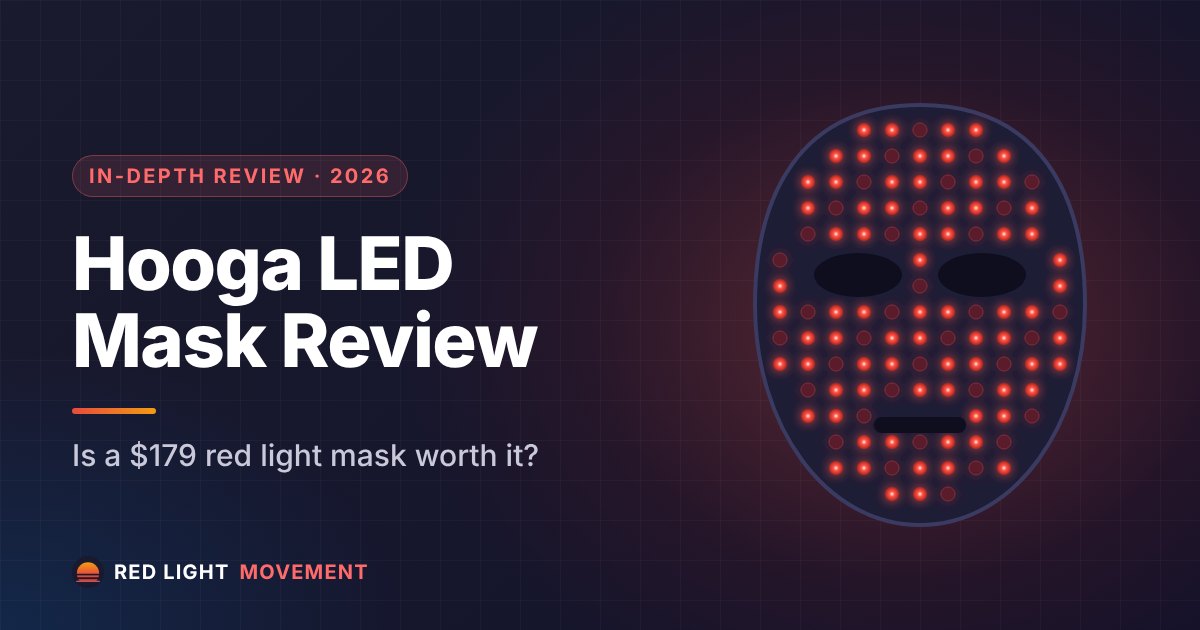
Hooga LED Face Mask at a Glance
| Price | $179 face mask · $99 neck piece · $249 face + neck combo |
| LEDs | 66 tri-chip LEDs (face); 48 tri-chip LEDs (neck) |
| Wavelengths | 630nm + 660nm red, 850nm near-infrared |
| Stated irradiance | 50 mW/cm² at the surface |
| Session timer | 5, 10, 15 or 20 minutes with auto shut-off |
| Modes | 4 brightness levels; continuous or pulsed (73, 146, 292 Hz) |
| Power | Cordless; rechargeable controller (3,000 mAh face, 5,000 mAh combo), USB-C |
| Build | Flexible silicone, adjustable strap, 2 silicone eye guards; 0.39 lb (face) |
| FDA status | Not FDA-cleared (Hooga makes no clearance claim) |
| Warranty / returns | 1-year warranty; 60-day returns (return shipping deducted) |
| HSA/FSA | Listed by Hooga as HSA/FSA eligible |
Face, Neck or Combo: Which Version Should You Buy?
Hooga sells the mask in three configurations that all run off the same rechargeable controller:
- Face Mask Only ($179): the right choice for most people. It covers the forehead, around the eyes, cheeks, mouth and jawline.
- Neck Only ($99): a separate piece for the neck and upper chest (décolletage). On its own it makes sense only if your concern is specifically neck lines or crepey skin.
- Face + Neck Combo ($249): both pieces plus the larger 5,000 mAh battery. It saves $29 versus buying them separately and is the better pick if you'd otherwise end up adding the neck piece later.
Our take: start with the face mask. The neck piece is a nice add-on, but the face is where most of the research on red light and skin was done.
The Specs, Explained
Wavelengths: 630nm, 660nm and 850nm
The mask uses two red wavelengths (630nm and 660nm) and one near-infrared wavelength (850nm), delivered by tri-chip LEDs. That's the same broad combination most skin studies use: visible red in the 630–660nm range acts on the outer layers of skin, while near-infrared reaches a little deeper. Many premium masks use 633nm + 830nm, which is functionally very similar. If you want the background, see our guide to red vs near-infrared light.
One thing it doesn't have is blue light (around 415nm), which some masks add for acne. If breakouts are your main concern, read our red light for acne guide before choosing.
Irradiance and dose
Hooga lists irradiance as 50 mW/cm² at the surface. Surface figures are the highest number a device can quote, because light spreads out as it travels, so treat it as a ceiling rather than what every part of your face receives. Even so, the math is reasonable for a mask that sits close to the skin: at 50 mW/cm², a 10-minute session delivers up to about 30 J/cm², which sits inside the range used in most skin research. You don't need more than that; with red light, more is not always better. Our irradiance and dosing guide explains how to read these numbers.
Pulse modes
Besides continuous light, the mask can pulse at 73, 146 or 292 Hz (so-called Nogier frequencies). The evidence that pulsing improves skin results is thin, so we'd use continuous mode by default. Having the option doesn't hurt.
Cordless design and comfort
The flexible silicone shell and battery controller mean you can walk around, read or make coffee during a session instead of sitting next to an outlet. At 0.39 lb for the face mask, it's light. Flexible masks also tend to sit closer to the skin than rigid shells, which helps deliver light evenly. Two silicone eye guards are included.
Warranty, returns and support
The mask carries a 1-year warranty, shorter than the 3 years Hooga offers on its panels, and returns are accepted within 60 days of delivery with return shipping deducted from the refund. That's a fair trial window: most people know within 6–8 weeks whether they'll keep up the habit.
What the Research Supports
LED masks are one of the better-studied uses of red light. A few results worth knowing:
- A controlled trial of 136 volunteers (Wunsch & Matuschka, Photomedicine and Laser Surgery, 2014) found that twice-weekly red light sessions over 30 treatments improved skin complexion and roughness and increased collagen density compared with controls.
- Earlier LED studies using 633nm red and 830nm near-infrared light (for example Lee et al., Journal of Photochemistry and Photobiology B, 2007) reported improvements in wrinkles and skin elasticity over several weeks of treatment.
Two caveats. First, these studies used clinical devices, not this specific mask, so they tell you the approach can work, not that every mask will produce the same result. Second, results are gradual: most studies measured change after 8–12 weeks of consistent use. Expect subtle improvements in tone and texture first, and treat any claim of dramatic results in days with skepticism. For a deeper look, see red light therapy for wrinkles and our complete skin guide.
Hooga vs CurrentBody vs Omnilux
| Hooga Face Mask | CurrentBody Skin LED Mask | Omnilux Contour Face | |
|---|---|---|---|
| Price | $179 | ~$380* | ~$395* |
| Wavelengths | 630 / 660 / 850nm | 633 / 830nm | 633 / 830nm |
| FDA-cleared | No | Yes | Yes |
| Neck add-on | Yes ($99) | Sold separately | Sold separately |
| Read more | Hooga → | CurrentBody vs Omnilux → | |
*Competitor prices as last listed on our LED mask roundup; check the brand site for current pricing.
The trade-off is simple. CurrentBody and Omnilux cost roughly twice as much, and in return you get FDA clearance and brands with their own published clinical data. Hooga gives you a similar wavelength mix, a cordless design and an optional neck piece for less, without the clearance. If you've been on the fence because of price, the Hooga mask is a reasonable way to find out whether you'll stick with a daily routine. If you have sensitive skin, a medical skin condition, or simply want the most-tested option, an FDA-cleared mask is the safer pick. Our FDA-cleared vs not guide explains what clearance does and doesn't mean.
Pros & Cons
Pros
- About half the price of leading FDA-cleared masks
- Red (630/660nm) + near-infrared (850nm) wavelength mix
- Cordless, light, flexible silicone fit
- Adjustable timer, brightness and pulse settings
- Optional neck piece on the same controller
- 60-day returns; listed as HSA/FSA eligible
Cons
- Not FDA-cleared
- Irradiance quoted at the surface only
- 1-year warranty (vs 3 years on Hooga panels)
- No blue light for acne
- Return shipping is deducted from refunds
How to Use the Hooga Mask
- Start with clean, dry skin. Remove makeup and sunscreen, which can block light. Apply serums after the session, not before.
- Use the eye guards and keep your eyes closed. Red light is low-risk, but the LEDs are bright.
- Begin with 10 minutes, 3–5 times a week, in continuous mode. Hooga's guidance ranges from 5–10 minutes daily to 5–20 minutes a few times a week; consistency matters more than session length.
- Give it 8–12 weeks before judging results. Take a photo in the same light at the start so you can compare.
- Wipe the silicone with a damp cloth after use and recharge the controller over USB-C.
New to red light? Our first 30 days guide and how often to use red light therapy cover routines in more detail.
Who Should (and Shouldn't) Buy It
Good fit if you: want to try an LED mask without spending $400; care mainly about fine lines, tone and texture; like the idea of using it while doing something else; or want to add the neck and chest later.
Look elsewhere if you: want an FDA-cleared device; mainly need help with acne (look for a mask with blue light); or would rather treat face and body — in that case a small panel like the Hooga HG300 ($199) gives you more flexibility, though it isn't hands-free.
Safety note: check with a doctor first if you're pregnant, take photosensitizing medication, or have a history of skin cancer or a light-sensitive condition. See our contraindications guide.
Frequently Asked Questions
Is the Hooga LED face mask FDA-cleared?
No. Hooga doesn't claim FDA clearance for the mask, and its product page notes the statements haven't been evaluated by the FDA. Masks like CurrentBody and Omnilux are FDA-cleared, which is one reason they cost about twice as much. Our FDA-cleared LED mask guide lists their 510(k) numbers.
How much does the Hooga red light mask cost?
As of October 2026, the face mask is $179, the neck piece is $99, and the face + neck combo is $249. Many red light brands discount during Black Friday, so check our Black Friday deals page in late November.
What wavelengths does the Hooga mask use?
It uses tri-chip LEDs at 630nm and 660nm (red) and 850nm (near-infrared). That's similar to the 633nm + 830nm combination used by many premium masks and in much of the skin research.
How long until you see results from an LED face mask?
Most studies measured improvements after 8–12 weeks of regular sessions (several times a week). Expect gradual changes in tone and texture rather than overnight results.
Does the Hooga mask help with acne?
Red and near-infrared light may help calm inflammation, but the mask has no blue light, which targets acne-causing bacteria. If acne is your main concern, compare options in our red light for acne guide.
Can I use HSA or FSA funds for the Hooga mask?
Hooga lists the mask as HSA/FSA eligible. Rules depend on your plan, and some require a Letter of Medical Necessity. See our HSA/FSA guide.