
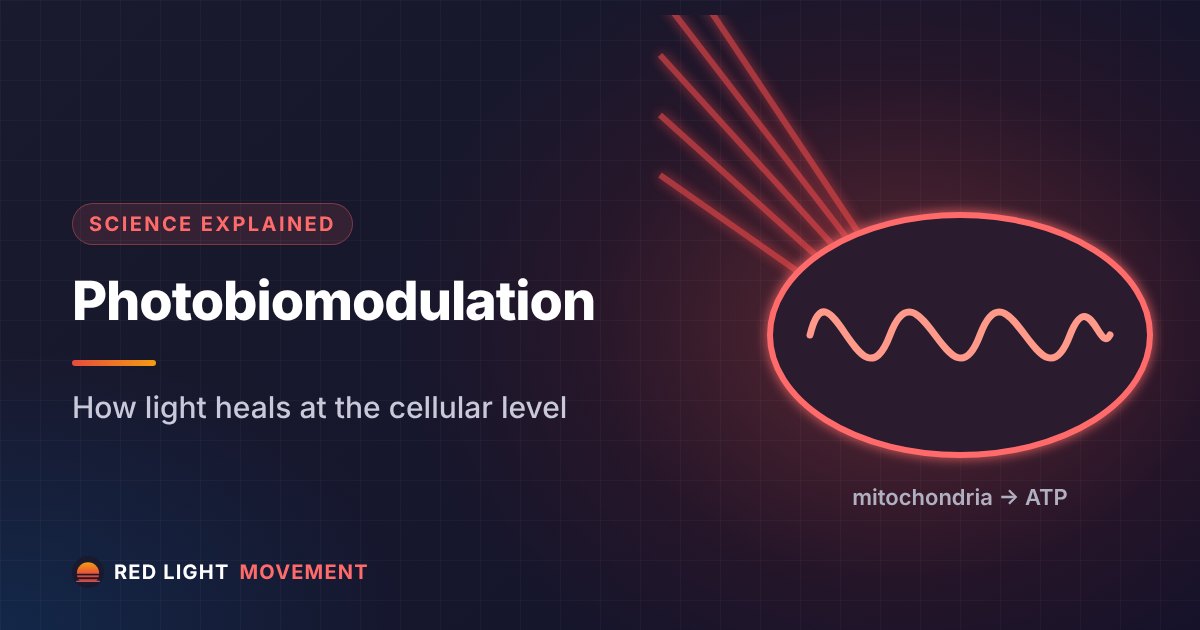
Photobiomodulation — sometimes shortened to PBM and more commonly known as red light therapy — is the use of specific wavelengths of red and near-infrared light to influence biological tissue. It is the same underlying mechanism whether the device is a clinical low-level laser, a full-body LED panel, or a handheld wrap on your knee. This guide breaks down what photobiomodulation actually does inside your cells, what the research supports, and what to look for if you want to use it at home.
The short version: when red and near-infrared light hit your skin, photons are absorbed by molecules inside your cells. Studies suggest this absorption can shift the activity of your mitochondria, modulate inflammation, and influence local blood flow. None of those effects are magic — they are reasonably well-documented mechanisms — but they are also smaller and more conditional than most marketing material implies. The aim of this guide is to give you the actual science without the hype.
Table of Contents
- What Photobiomodulation Actually Is
- The Cellular Mechanism: Cytochrome c Oxidase, ATP, and Light
- Why 660nm and 850nm Are the Workhorse Wavelengths
- Dosing, Irradiance, and the Biphasic Response
- What the Clinical Evidence Actually Shows
- Photobiomodulation vs Other Light Therapies
- Choosing an At-Home Photobiomodulation Device
- FAQ
What Photobiomodulation Actually Is
Photobiomodulation is the formal scientific term that has largely replaced older labels like low-level laser therapy (LLLT), low-level light therapy (LLLT), cold laser therapy, and soft laser therapy. The North American Association for Photobiomodulation Therapy adopted "photobiomodulation" in 2014 specifically because the older terms tied the field to lasers, while the actual mechanism works equally well with non-coherent LED light. That distinction matters because it is the reason at-home LED panels can do the same fundamental thing as clinical laser treatments.
The defining features of photobiomodulation are:
- Specific wavelengths. Most therapeutic effects are documented in the visible red (around 630–670nm) and near-infrared (around 800–880nm) ranges. Wavelengths outside these windows do not interact with the same target molecules in the same way.
- Low intensities. Photobiomodulation uses non-thermal doses. The light should warm the skin only mildly, if at all. The mechanism is photochemical, not heat-driven.
- Sub-cellular targets. The biological effects begin inside the cell, primarily at the mitochondria, before propagating outward to tissue-level effects like blood flow and inflammation signaling.
If a treatment uses these three features, it falls under photobiomodulation — whether it is delivered by a clinical laser, a wearable wrap, or a six-foot LED panel.
The Cellular Mechanism: Cytochrome c Oxidase, ATP, and Light
The most widely accepted mechanism of photobiomodulation centers on a single molecule: cytochrome c oxidase (often abbreviated CCO). It is the fourth and final enzyme in the electron transport chain, the part of the mitochondria that produces ATP — the cell's primary energy currency.
Cytochrome c oxidase has multiple absorption peaks for light, with prominent ones in the red and near-infrared windows. Research published in journals such as the Journal of Photochemistry and Photobiology B and Photonics & Lasers in Medicine indicates that when photons in these ranges are absorbed by CCO, several downstream effects may follow:
- Increased ATP production. Studies suggest that absorbed photons may dissociate inhibitory nitric oxide from CCO, allowing the enzyme to operate more efficiently and increase ATP output, at least transiently.
- Modulated reactive oxygen species (ROS). Brief, low-level increases in mitochondrial ROS appear to act as signaling molecules that activate cellular repair pathways and antioxidant defenses.
- Released nitric oxide. The displaced nitric oxide may diffuse into surrounding tissue, where it acts as a vasodilator and signaling molecule, potentially supporting local blood flow.
Downstream of those primary events, research has documented effects on gene expression, growth factor release, anti-inflammatory cytokine signaling, and stem cell activity. The full picture is still being mapped, but the foundational claim — that red and near-infrared light interact meaningfully with cellular machinery — is supported by a substantial body of biochemistry research.
For a deeper dive into how this translates into tissue-level effects, see our companion guide on the science of red light therapy.
Why 660nm and 850nm Are the Workhorse Wavelengths
Most consumer red light therapy devices feature two wavelengths: 660nm (red) and 850nm (near-infrared). These specific numbers are not arbitrary — they sit close to absorption peaks of cytochrome c oxidase, and they correspond to "optical windows" in human tissue where blood and water absorb relatively little light, allowing photons to reach deeper structures.
The practical difference between the two:
- 660nm (red). Penetrates roughly 1–5mm into tissue. Best suited for skin-level applications: complexion, fine lines, surface wound healing, scalp.
- 850nm (near-infrared, invisible). Penetrates roughly 1–3cm into tissue. Best suited for muscles, joints, tendons, and deeper structures.
Most modern panels and wraps include both wavelengths so a single device can address surface and deeper targets. We cover the practical tradeoffs in detail in 660nm vs 850nm and red light therapy wavelengths.
🔴 Best Dual-Wavelength PBM Panel for Most People
The Hooga HGPro1500 combines 660nm red and 850nm near-infrared LEDs in a high-irradiance full-body panel. It hits both photobiomodulation absorption peaks, delivers a therapeutic dose in 10–15 minute sessions, and is one of the best-value full-spectrum panels we cover.
Dosing, Irradiance, and the Biphasic Response
Photobiomodulation has one feature that often surprises newcomers: more is not better. The field has long described a biphasic dose response (sometimes called the Arndt-Schulz curve). At low doses, you see little effect. At an optimal dose, you see meaningful biological effects. At excessive doses, the effects flatten or even reverse — the same wavelengths that helped at 60 seconds per area can stop helping (or hinder) at 30 minutes per area.
Two terms govern dosing:
- Irradiance (mW/cm²) — how much light energy hits a given area per second. Modern LED panels typically deliver 30–200 mW/cm² depending on distance.
- Fluence or dose (J/cm²) — the total energy delivered per unit area, calculated as irradiance × time. Most clinical studies use doses in the range of 3–60 J/cm² per session.
For a typical at-home panel, this works out to sessions of about 10–20 minutes per body area at a distance of 6–12 inches. Going much longer than that does not generally produce additional benefit and may produce less. We dig into the math and the reasoning in our irradiance and dosing guide and our session frequency guide.
What the Clinical Evidence Actually Shows
It is easy to find articles claiming photobiomodulation does everything from regrowing organs to curing depression. That is not what the actual literature supports. The honest summary, based on systematic reviews and meta-analyses to date, is closer to this:
Strong evidence base
- Musculoskeletal pain. Multiple meta-analyses, including reviews in the Journal of Pain Research and The Lancet, have reported clinically meaningful pain reduction and improved function in conditions such as knee osteoarthritis and chronic neck pain when appropriate doses and wavelengths are used.
- Wound healing. Photobiomodulation has decades of evidence supporting accelerated healing of certain wound types, particularly in dental and dermatological contexts.
- Exercise recovery. Reviews in Lasers in Medical Science indicate that pre- or post-exercise photobiomodulation may reduce delayed onset muscle soreness and creatine kinase levels.
Moderate, growing evidence base
- Skin and aging. Studies suggest improvements in fine lines, complexion, and certain inflammatory skin conditions like acne. Effect sizes are modest but consistent.
- Hair regrowth in androgenetic alopecia. Several FDA-cleared devices have shown modest but real density increases in clinical trials.
- Tendinopathy and overuse injuries. Growing evidence for conditions like Achilles tendinopathy and plantar fasciitis, though optimal dosing is still being refined.
Emerging or mixed evidence
- Sleep, mood, cognition, and metabolic effects. Smaller studies are interesting, but the literature is far from settled. Treat marketing claims in these areas with caution.
- Transcranial photobiomodulation. Active research area, but most consumer head-mounted devices substantially outpace the underlying evidence.
For a complete walk-through of the strongest studies and where they apply, see our red light therapy benefits pillar.
Photobiomodulation vs Other Light Therapies
Several light-based therapies share the marketing space but operate by different mechanisms. Knowing the differences helps you avoid buying the wrong device for the job.
- Photobiomodulation (red and near-infrared light). Photochemical mechanism via cytochrome c oxidase. Targets ATP, inflammation signaling, blood flow.
- Blue light therapy (around 415nm). Antimicrobial mechanism — targets porphyrins in P. acnes bacteria. Useful for acne, distinct from PBM. See red vs near-infrared for related comparisons.
- UV phototherapy. Used clinically for psoriasis, vitiligo, and similar conditions. Mechanism involves DNA damage and immune modulation; not the same biological pathway as PBM.
- Far-infrared sauna. Primarily generates heat. Provides thermal benefits (cardiovascular, sweat-driven detoxification) but is not the same photochemical mechanism as PBM.
- Bright light therapy (10,000-lux white light). Used for circadian rhythm and seasonal affective disorder. The therapeutic mechanism here involves the eye and the suprachiasmatic nucleus, not mitochondrial absorption in tissue.
Choosing an At-Home Photobiomodulation Device
If you have decided photobiomodulation is worth experimenting with, the practical question becomes: what device makes sense? The answer depends on what you want to treat.
For Whole-Body or Multi-Area Use — Full-Body Panel
If you plan to treat your back, chest, abs, legs, and arms — or anything beyond a single small target — a full-body panel is the most efficient option. Look for dual wavelengths (660nm + 850nm), measured irradiance of at least 100 mW/cm² at 6 inches, and a third-party EMF reading you trust.
🔴 Best Mid-Size Panel for Targeted Photobiomodulation
The Hooga HG1500 is a popular mid-size dual-wavelength panel. It covers a torso or paired joints in a single session and pairs nicely with a wrap for spot treatment. A solid step into PBM without the footprint or price of a full-body unit.
For Joints, Knees, and Localized Pain — Wrap or Belt
Wraps deliver the highest skin-level dose because they sit directly on the body — no distance, no air gap. They are usually the best value for a single-area problem like knee arthritis, lower back stiffness, or post-workout calf recovery.
🪗 Best Wrap for Knee & Joint PBM
The Hooga Red Light Therapy Knee Massager is a purpose-built wrap that combines 660nm and 850nm LEDs with optional heat. Ideal for arthritis, post-run recovery, or chronic joint discomfort.
For Face, Hands, and Small Areas — Mini Panel or Handheld
Smaller devices work well for facial use, hands, and spot treatment. A small panel like the Hooga HGPro300 sits on a desk; handheld units travel easily and are well-suited to localized soreness or skin spots. We round these up in our best handheld devices guide. For face-specific applications, see our best red light masks roundup. Amazon also carries a wide range of inexpensive options — see our breakdown of the trustworthy ones in Amazon red light therapy.
The Bottom Line
Photobiomodulation is a real biological mechanism with a substantial research base behind it. Specific wavelengths of red and near-infrared light interact with cytochrome c oxidase in your mitochondria, and that interaction has measurable downstream effects on energy production, inflammation, and circulation. The strongest clinical evidence currently sits in musculoskeletal pain, wound healing, and exercise recovery, with growing support for skin, hair, and certain overuse injuries.
The mechanism is not magic, the doses matter, and the marketing in this space frequently overshoots what the evidence actually supports. But for the specific applications where research is solid — joint pain, recovery, skin, scalp — a well-built dual-wavelength device used consistently is one of the more practical wellness tools you can own. Once you have the device, every additional session is essentially free.
📚 Related Reading
Frequently Asked Questions
What is photobiomodulation in simple terms?
Photobiomodulation (PBM) is the use of specific wavelengths of red and near-infrared light to influence biological tissue. The light is absorbed by molecules inside cells — most notably cytochrome c oxidase in mitochondria — and research suggests this can affect cellular energy production, inflammation signaling, and circulation.
Is photobiomodulation the same as red light therapy?
Yes, in most modern usage they refer to the same underlying mechanism. "Photobiomodulation" is the scientific term used in research papers, while "red light therapy" is the consumer-facing name. Low-level laser therapy (LLLT) and low-level light therapy are also closely related terms that fall under the photobiomodulation umbrella.
Which wavelengths are used in photobiomodulation?
The most studied therapeutic wavelengths fall in two ranges: visible red (typically 630–670nm) and near-infrared (typically 800–880nm). 660nm and 850nm are the two most commonly used in modern LED-based devices because they sit near peak absorption windows for cytochrome c oxidase and penetrate tissue effectively.
Does the science behind photobiomodulation actually hold up?
The mechanism — light absorption by cytochrome c oxidase leading to downstream effects on ATP, reactive oxygen species, and nitric oxide — is well-supported in the research literature. Clinical evidence is strongest for musculoskeletal pain, wound healing, and certain skin conditions, with growing but more variable evidence for other applications. Outcomes depend heavily on wavelength, dose, and consistency.
Can you get too much photobiomodulation?
Yes. Photobiomodulation follows a biphasic dose response, sometimes called the Arndt-Schulz curve. Too little light produces little effect, an optimal dose produces benefits, and excessive doses may reduce or even reverse the benefits. This is one reason most protocols recommend 10–20 minute sessions rather than hour-long ones.
How is photobiomodulation different from heat therapy or infrared sauna?
Photobiomodulation uses specific narrow wavelengths of red and near-infrared light at low intensities — its mechanism is photochemical, not thermal. Far-infrared saunas use longer wavelengths primarily to generate heat. The two can be complementary, but they work through different biological pathways.
Is at-home photobiomodulation as effective as clinical lasers?
Modern at-home LED devices deliver lower irradiance than clinical class IV lasers, but they can deliver therapeutic doses with longer or more frequent sessions. For most consumer applications — skin, recovery, joint pain, general wellness — well-built LED panels and wraps from reputable brands produce results consistent with the research literature.