
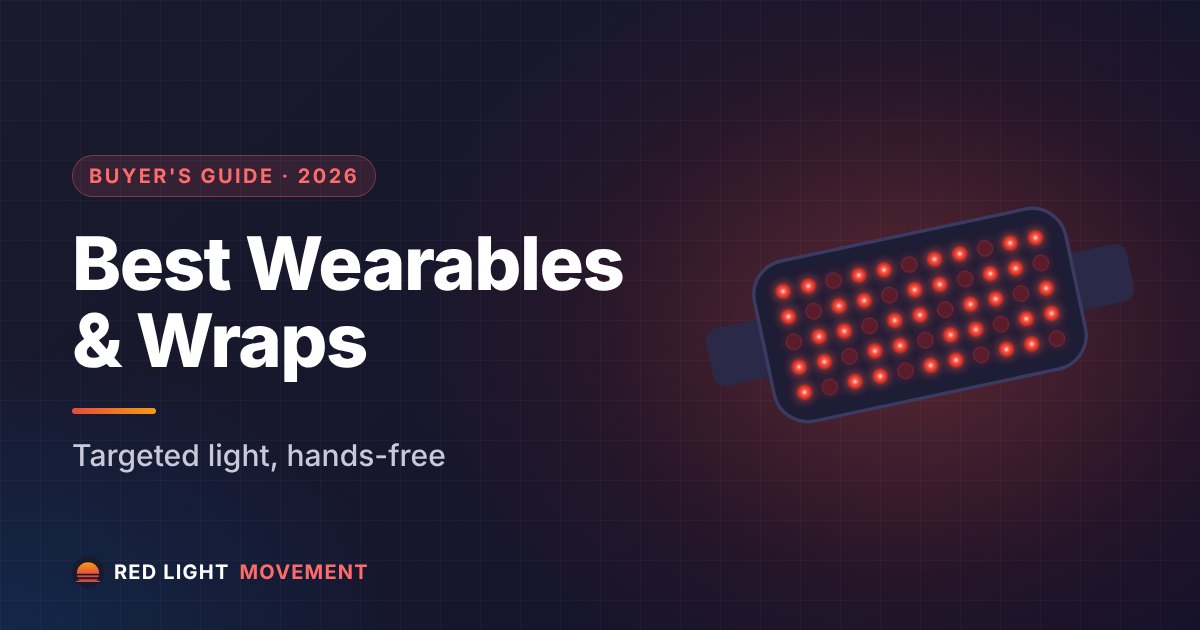
Red light therapy wearables and wraps have become one of the fastest-growing segments of the photobiomodulation market — and for good reason. While full-size panels remain the gold standard for whole-body treatment, wearables offer something panels cannot: hands-free, targeted therapy that maintains perfect contact with your skin while you read, work at a desk, or simply relax on the couch. For people dealing with a specific joint issue, localized pain, or skin concern, a well-designed wearable may actually deliver better results than a panel for that particular treatment area.
The challenge is separating legitimate therapeutic devices from the flood of low-powered, misleadingly marketed products — especially on Amazon, where red light "therapy" gadgets range from $15 novelties to $300+ professional-grade wraps. In this guide, we review the best red light therapy wearables across every category: knee wraps, shoulder and body wraps, face masks, belts, and portable devices. We evaluate each on irradiance, wavelength accuracy, build quality, comfort, and value per therapeutic dose.
This is an affiliate review — we earn commissions through some of the links below — but our analysis is independent. For a deeper look at full-size panels, see our best red light therapy panels guide. For wraps specifically, our best wraps roundup goes deeper on that category.
Table of Contents
- Wearables vs Panels: When to Choose What
- What to Look for in a Red Light Therapy Wearable
- Best Red Light Therapy Knee Wraps
- Best Shoulder & Body Wraps
- Best Red Light Therapy Face Masks
- Best Red Light Therapy Belts & Pads
- Best Portable & Travel Wearables
- Dosing Tips for Wearable Devices
- What to Avoid: Red Flags in Wearable Products
- Our Verdict: Best Wearables by Use Case
- Frequently Asked Questions
Wearables vs Panels: When to Choose What
The first question most buyers ask is whether a wearable can replace a full-size panel. The short answer: it depends entirely on your goals.
Wearables excel at targeted treatment. If you have a specific knee injury, chronic shoulder pain, facial skin concerns, or localized inflammation, a wearable that sits directly against the affected area can deliver a concentrated dose more efficiently than standing at a distance from a panel. Research on photobiomodulation consistently shows that closer proximity to the light source increases the energy density reaching target tissue (Heiskanen and Hamblin, 2018, Photobiomodulation, Photomedicine, and Laser Surgery). Wraps and wearables eliminate the distance variable entirely by maintaining skin contact.
Panels excel at systemic treatment. For whole-body benefits — improved sleep, general inflammation reduction, systemic recovery from training, mood enhancement — you need large-area coverage that wearables simply cannot provide. A full-body panel delivering light to your torso, legs, and arms simultaneously triggers systemic biological responses that a knee wrap cannot replicate.
The ideal setup is both. Many experienced red light therapy users combine a full-body panel for daily systemic sessions with a targeted wearable for specific problem areas. The wearable allows you to add extra dose to a joint or muscle group without extending your panel session time.
What to Look for in a Red Light Therapy Wearable
Not all wearables deliver therapeutic-level light. Here are the specifications that matter:
Wavelength
Look for devices that specify 660nm (visible red) and/or 850nm (near-infrared). These two wavelengths have the strongest clinical evidence for photobiomodulation. Devices that list vague claims like "red light" or "infrared" without specifying exact nanometer wavelengths are often using off-peak LEDs that may not deliver therapeutic benefit. For joint and muscle issues, 850nm near-infrared is particularly important because it penetrates deeper into tissue. For skin concerns, 660nm is the priority. Dual-wavelength devices cover both bases. See our wavelength guide for the full science.
LED Count and Irradiance
More LEDs generally means better coverage and higher total energy output over the treatment area. However, LED count alone doesn't determine effectiveness — irradiance (power density in mW/cm²) at the skin surface is what matters. For wearables in direct skin contact, irradiance of 20–50 mW/cm² is typical and sufficient because the zero-distance delivery eliminates the inverse square law losses that panels face. Look for devices with at least 50+ LEDs for joint wraps and 100+ for larger body wraps.
Build Quality and Comfort
You'll be wearing these devices for 10–20 minutes per session, often daily. Comfort matters. Look for flexible materials (medical-grade silicone or neoprene), adjustable straps or velcro closures, and a design that conforms to the body part without pressure points. Poor-quality wraps with rigid LED strips can create hot spots and uneven coverage.
Power Source and Portability
Most wearables run via USB power or a wall adapter. Some higher-end models include rechargeable batteries for cordless use. Battery-powered devices are more convenient but typically lower-powered. For home use, a corded device delivers more consistent output. For travel or office use, battery power adds meaningful convenience.
Best Red Light Therapy Knee Wraps
Knee wraps are the most popular wearable category, driven by the high prevalence of knee osteoarthritis, runner's knee, post-surgical recovery, and general joint pain. Research suggests red and near-infrared light may help reduce knee joint inflammation and support cartilage health. A 2019 systematic review in BMC Musculoskeletal Disorders (Stausholm et al.) found that photobiomodulation significantly reduced pain and improved function in knee osteoarthritis patients across multiple randomized controlled trials.
Top Pick: Hooga Red Light Therapy Knee Device
The Hooga Red Light Therapy Knee Device is our top recommendation for knee-targeted treatment. It combines 660nm and 850nm dual-wavelength LEDs with a wrap-around design that conforms to the knee joint. Hooga has built a strong reputation for delivering legitimate therapeutic irradiance at budget-friendly prices — the same value proposition that makes their full-size panels our top budget pick.
The device features adjustable velcro straps that accommodate different knee sizes, and the flexible design maintains good LED-to-skin contact around the curved joint surface. Sessions run 10–15 minutes, and the device connects via a standard power adapter. At its price point (typically under $100), it delivers significantly more therapeutic value than most Amazon alternatives.
Runner-Up: Amazon Budget Knee Wraps
For buyers on a tighter budget, Amazon offers several knee wraps in the $40–$80 range. Quality varies significantly. When shopping Amazon, prioritize listings that specify exact wavelengths (660nm/850nm), show LED count, and have verified purchase reviews mentioning actual pain relief — not just "nice red light." Be skeptical of devices under $30; most lack the irradiance to deliver a therapeutic dose in a reasonable session time.
Best Shoulder & Body Wraps
Shoulder wraps and larger body wraps address a wider treatment area. These are popular for rotator cuff issues, upper back tension, neck pain, and general muscle recovery. The challenge with shoulders and torso is maintaining consistent contact across a curved, moving body surface.
Top Pick: Hooga HGPro Wrap Series
Hooga's wrap lineup extends beyond the knee to include shoulder, back, and multi-purpose wraps that use the same dual-wavelength (660nm/850nm) LED technology. The Hooga HGPro 300 — while primarily marketed as a small panel — is compact enough to be used as a targeted device for shoulders and upper back when positioned with a strap or held in place. Its 300 LEDs provide solid coverage for a focused treatment zone.
For a dedicated wearable form factor, Hooga's shoulder and body wraps use flexible neoprene construction with embedded LEDs. They wrap securely around the shoulder or torso, maintaining contact through the session. Pricing typically falls in the $80–$150 range — competitive for the LED count and wavelength specifications offered.
Alternative: Large-Area LED Pads
For back and torso coverage, flexible LED pads offer a different approach. These lay flat across the treatment area rather than wrapping around it. Several options on Amazon in the $100–$200 range provide reasonable coverage. The advantage of pads is larger treatment area; the disadvantage is that they don't conform as tightly to curved body surfaces, which can create uneven dosing.
Best Red Light Therapy Face Masks
Red light therapy face masks have exploded in popularity thanks to the growing body of evidence supporting photobiomodulation for skin rejuvenation. Research indicates that 660nm red light may stimulate collagen production, reduce fine lines, and improve skin texture, while 850nm near-infrared light penetrates deeper to address inflammation and support cellular repair (Wunsch and Matuschka, 2014, Photomedicine and Laser Surgery). See our guides on red light therapy for skin and red light therapy for acne for the full evidence review.
What Separates Good Face Masks from Gimmicks
The face mask category has the widest quality gap in the entire wearable market. Premium masks ($150–$500) use medical-grade silicone, specific 660nm/850nm wavelengths, adequate LED density, and comfortable fit. Budget masks ($20–$60) often use generic red LEDs at non-therapeutic wavelengths, too few LEDs for meaningful coverage, and flimsy construction that allows light to scatter away from the skin.
When evaluating face masks, prioritize: exact wavelength specifications, LED count (100+ for adequate facial coverage), comfortable fit that doesn't create pressure on the nose bridge, and eye protection — either built-in shields or included goggles. Our best red light therapy masks page has our full ranked recommendations.
Budget Face Mask Option
For buyers who want to try facial red light therapy without a large investment, Amazon's mid-range face masks ($60–$120) offer a reasonable entry point. Look for masks specifying 660nm wavelength, 100+ LEDs, and silicone construction. Avoid anything marketed primarily as a "beauty device" without therapeutic wavelength specifications — these are often low-powered LED arrays that look impressive but deliver minimal photobiomodulation.
Best Red Light Therapy Belts & Pads
Red light therapy belts and pads are designed for abdominal, lower back, and hip treatment. These are popular among users targeting gut inflammation, lower back pain, and — with increasing interest — fat loss applications. Research on red light therapy and adipose tissue is still emerging, but several studies suggest photobiomodulation may influence adipocyte function and support body composition changes when combined with exercise (Sene-Fiorese et al., 2015, Lasers in Medical Science). See our red light therapy for weight loss guide for a balanced review of the evidence.
Belt-Style Wearables
Belt-style devices wrap around the midsection and typically feature 100–200+ LEDs in a flexible band. The best models use dual-wavelength 660nm/850nm LEDs and provide adjustable sizing to accommodate different waist measurements. Pricing ranges from $80–$200 depending on LED count and build quality. Amazon has several options in this category worth considering.
For lower back pain specifically, a belt-style wearable can be more practical than a panel — you can wear it while sitting at a desk, and the direct contact delivers consistent dosing to the lumbar region. If back pain is your primary concern, also see our red light therapy for pain pillar and our upcoming back pain protocol guide.
Pad-Style Wearables
Pads are flat, flexible mats embedded with LEDs that you can drape over or lie on. They're more versatile than wraps — you can position them on your back while lying down, drape them over your thighs, or wrap them loosely around larger body areas. The tradeoff is that pads generally don't maintain as tight skin contact as wraps, which can reduce dosing consistency. High-quality pads in the $150–$300 range with 200+ dual-wavelength LEDs can be a good complement to a panel setup.
Best Portable & Travel Wearables
For frequent travelers or anyone who wants red light therapy at the office, portable wearables fill a niche that panels cannot. The key tradeoff is power: battery-operated devices typically deliver lower irradiance than corded devices, meaning longer session times for equivalent dosing.
Portable Handheld Devices
While not technically "wearables," handheld red light devices are the most portable option available. Small, battery-powered units with focused LED arrays can target specific spots — a sore wrist, a tension point on the neck, or a facial treatment area. These typically use 10–30 LEDs and deliver modest irradiance, making them best suited as supplemental devices rather than primary treatment tools. See our best handheld red light devices guide for our full rankings.
Travel-Friendly Wraps
Some wraps are designed specifically for portability, with USB-C power (usable with a portable battery pack), foldable construction, and lightweight materials. If you travel frequently and want to maintain your red light therapy routine on the road, a USB-powered knee or shoulder wrap paired with a 10,000 mAh battery pack is a practical solution. Look for devices under 200g that fold flat for packing.
Dosing Tips for Wearable Devices
Dosing with wearables differs from panel dosing because the light source sits directly against your skin rather than at a distance. This changes the irradiance calculation and optimal session length.
Contact irradiance is lower than you might expect. While panels are measured at 6 inches (15 cm) and produce 100–150 mW/cm², wearable LEDs in direct skin contact typically deliver 20–50 mW/cm² because they use smaller, lower-powered LEDs. This is by design — you don't need the same raw power when there's zero distance loss. A wearable delivering 30 mW/cm² for 15 minutes deposits approximately 27 J/cm², which falls within the therapeutic window for most applications.
Session length: 10–20 minutes per area. Most wearable manufacturers recommend 10–20 minute sessions, and this range aligns well with the research. The biphasic dose response in photobiomodulation means that more is not always better — exceeding optimal dose can actually reduce therapeutic benefit (Huang et al., 2009, Dose-Response). Stick to the manufacturer's recommended session time rather than assuming longer sessions produce better results.
Frequency: daily use is fine for most applications. Unlike some therapies where rest days are important, daily red light therapy is well-tolerated and supported by the research. Most clinical trials use daily or near-daily protocols. For chronic conditions like osteoarthritis, consistent daily use over 4–12 weeks produces the best outcomes.
Direct skin contact produces best results. Light does not penetrate through clothing effectively. Always use wearables directly against clean, dry skin for maximum energy delivery to target tissue.
What to Avoid: Red Flags in Wearable Products
The wearable red light therapy market has more misleading products than the panel market, partly because the lower price point attracts manufacturers prioritizing margin over therapeutic effectiveness. Watch for these warning signs:
No wavelength specification. If a product says "red light" or "infrared" without specifying exact nanometer values (e.g., 660nm, 850nm), the LEDs are likely generic and may not produce light at photobiomodulation-effective wavelengths. Legitimate therapeutic devices always specify their wavelengths.
Unrealistic health claims. Products claiming to "cure" arthritis, "eliminate" pain, or "reverse" aging are violating FTC guidelines and are more likely to be low-quality. Reputable brands use appropriate language like "may help" and "research suggests." See our FDA clearance guide for context on how red light devices are regulated.
Extremely low prices. Devices under $25 almost universally lack the LED quality and count to deliver therapeutic doses. The physics of LED manufacturing, power delivery, and heat management set a floor on what a legitimate device costs. Our budget guide covers how to find real value without overpaying.
No return policy or trial period. Reputable wearable brands offer at least a 30-day return window. Products with no return policy or difficult return processes suggest the manufacturer knows the product won't meet expectations.
Low EMF and flicker claims without data. Some products market "low EMF" or "flicker-free" without providing actual measurement data. While EMF and flicker are real considerations, unsupported claims about them are a marketing tactic rather than a quality indicator.
Our Verdict: Best Wearables by Use Case
Here's our summary of the best wearable for each common use case:
Quick Recommendations
- Best Knee Wrap: Hooga Knee Massager ($189) — dual-wavelength, proven brand; currently sold out, so see the Kineon MOVE+ Pro or the Hooga Torch ($139) meanwhile
- Best Shoulder/Body Wrap: Hooga body wraps — flexible design, 660nm/850nm, competitive pricing
- Best Face Mask: See our dedicated masks guide — this category is deep enough to warrant its own page
- Best Belt/Pad: Mid-range Amazon options ($100–$200) with 660nm/850nm and 150+ LEDs
- Best Portable: USB-powered travel wraps paired with a battery pack
- Best Overall Value: Hooga HGPro 300 — technically a small panel, but compact and versatile enough for targeted use
If you're starting from zero and want the most versatile setup, consider pairing a Hooga HGPro 1500 full-body panel for systemic treatment with a targeted wearable for your specific problem area. This combination covers both systemic and localized benefits at a total price point that's still well below premium alternatives like Joovv. See our best panels guide for the full comparison.
For a deeper dive into how wearables compare to other form factors, explore our best wraps roundup, best masks guide, and best handheld devices reviews.
Frequently Asked Questions
Are red light therapy wearables as effective as full-size panels?
For targeted treatment of a specific area — like a knee, shoulder, or face — wearables can be equally effective or even superior to panels because they maintain consistent distance and contact with the treatment area. However, they cannot replace full-body panels for systemic benefits like improved sleep, general inflammation reduction, or full-body recovery. Wearables are best used as complements to a panel or as standalone devices for people with a single, specific treatment goal.
What wavelengths should a red light therapy wearable use?
The most effective wearables use 660nm (visible red) for skin and superficial tissue treatment and 850nm (near-infrared) for deeper tissue penetration into joints, muscles, and tendons. Dual-wavelength devices that combine both are the most versatile. Some face masks also include 415nm blue light for acne-causing bacteria, though the evidence for red/NIR is stronger for most applications.
How long should I use a red light therapy wearable per session?
Most wearables deliver effective doses in 10–20 minutes per session. The optimal time depends on the device's irradiance — higher-powered wearables (30+ mW/cm²) may need only 10 minutes, while lower-powered devices may require 15–20 minutes. Follow the manufacturer's recommendations and aim for a total dose of 20–60 J/cm² per treatment area. Using a wearable longer than recommended may actually reduce effectiveness due to the biphasic dose response.
Can I use a red light therapy wrap while exercising?
Most wraps are designed for stationary use and connect to a power source via USB or wall adapter, making movement limited. Some battery-powered wearables allow light movement during treatment, but vigorous exercise is generally not recommended as it can shift the device and reduce treatment consistency. For pre-workout priming, use the wearable before your session. For recovery, use it within 1–2 hours after exercise.
Are cheap red light therapy wearables on Amazon worth buying?
Many sub-$50 wearables on Amazon use low-powered LEDs that may not deliver therapeutic irradiance levels. That said, there are legitimate budget options in the $60–$120 range from brands like Hooga that deliver real therapeutic doses. Check for specific wavelength claims (660nm and/or 850nm), LED count, and look for third-party irradiance verification before purchasing. See our budget guide for more on finding real value.
What is the difference between a wrap and a pad?
Wraps are flexible, contoured devices designed to secure around a specific body part (knee, shoulder, wrist) using velcro or straps. They maintain close contact with the skin for consistent dosing. Pads are flat, flexible mats that can be placed on or draped over larger areas like the back, abdomen, or thighs. Both use the same LED technology — the difference is form factor and intended treatment area.
Do I need eye protection when using a face mask?
Most red light therapy face masks are designed with eye cutouts or built-in eye shields to avoid direct LED exposure to the eyes. While 660nm red light at therapeutic doses has not been shown to cause eye damage in clinical studies, near-infrared (850nm) light is invisible and can be more intense than it feels. If your face mask includes NIR LEDs near the eye area and lacks built-in protection, wearing the included eye shields or keeping your eyes closed is a reasonable precaution. See our safety guide for more details.
Related Articles
Best Red Light Therapy Wraps 2026
Our full rankings of the best red light therapy wraps for knees, shoulders, back, and more.
12 min read
Best Red Light Therapy Masks 2026
The best red light therapy face masks for skin rejuvenation, acne, and anti-aging.
11 min read
Hooga Red Light Review: Best Budget Panel?
An honest, independent review of Hooga's full lineup — HGPro 1500, HG1500, HGPro 300, and knee wrap.
13 min read