
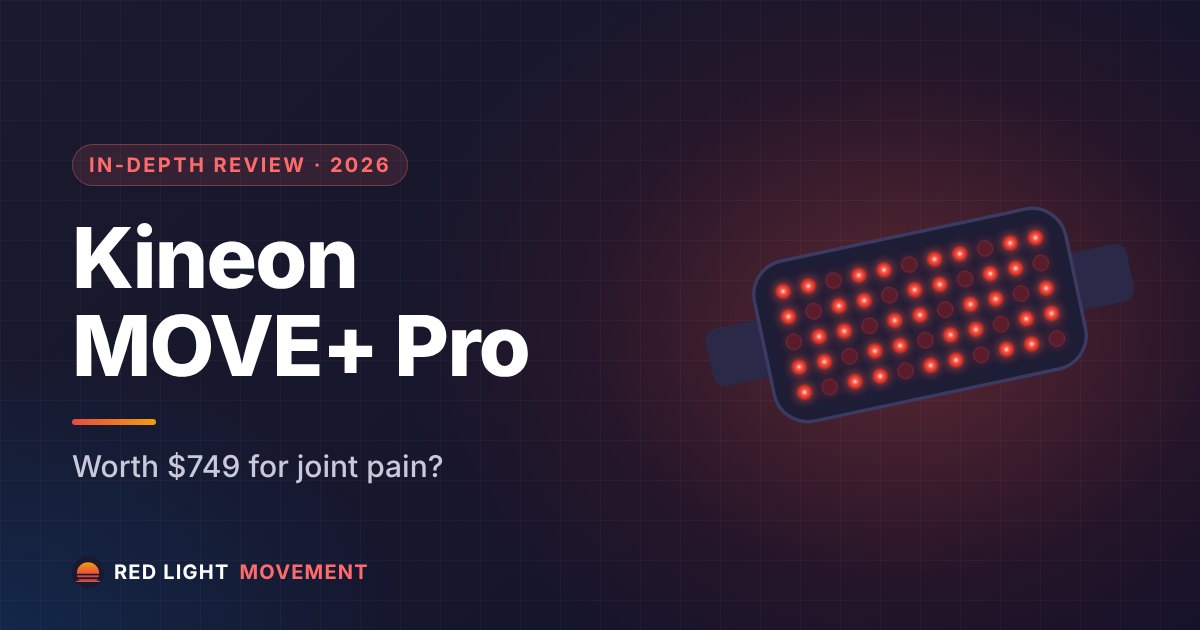
The Kineon MOVE+ Pro sits in an unusual category. It's not quite a red light therapy panel, not quite a wrap, and not quite a handheld wand. It's a strap-on wearable with three articulated modules, each housing 660nm LEDs and 808nm Class IIM lasers, designed primarily for targeted treatment of knees, elbows, ankles, and similar joints. At a list price around $749, it sits firmly in the premium tier of consumer photobiomodulation hardware.
Kineon has built a reputation over the past several years as one of the few brands successfully bringing medical-style laser therapy — the kind you might encounter in a chiropractor's office or a sports medicine clinic — into a consumer-friendly form factor. Athletes, ex-pro players, and physical therapists have publicly endorsed the device, and the company has invested in published research on its specific configuration. That's all genuinely uncommon for the price tier.
But premium positioning and celebrity endorsements aren't the same as good value for the average buyer. The question we'll work through in this review is straightforward: what does the MOVE+ Pro actually do that a $150 red light therapy wrap doesn't, and is the difference worth ~$600 to you? We'll cover the hardware, the wavelengths and laser specifications, what the available research says, real-world use, warranty, and the buyers we think should — and shouldn't — pull the trigger.
Note: Kineon is not currently one of our affiliate partners. We have no financial incentive to recommend the MOVE+ Pro. Where we link to alternative devices that we believe deliver better value for most buyers, those links may be affiliate links to brands we partner with — primarily Hooga for direct relationships and Amazon for everything else.
Table of Contents
What the MOVE+ Pro Actually Is
The MOVE+ Pro is a three-module wearable connected by a flexible strap system. Each module contains a small array of 660nm red LEDs surrounding a central 808nm near-infrared laser diode. The straps wrap around a joint — typically the knee, but the geometry is also intended to fit elbows, ankles, shoulders, and the lumbar back area — and the modules are positioned around the joint so the light delivers from multiple angles.
The user clicks a single button to start a 5-minute session. The device runs on internal rechargeable batteries. Kineon ships it with protective eyewear, a charging cable, and a carrying case. Out of the box, it is one of the more polished consumer photobiomodulation products from a build-quality and packaging standpoint. The straps and modules feel like medical equipment, not a fitness gadget.
The key conceptual difference between the MOVE+ Pro and a typical red light therapy wrap is the laser component. LEDs scatter light broadly; lasers deliver coherent, collimated light that penetrates more efficiently to a smaller, deeper treatment area. A traditional red light wrap might place 100+ LEDs across a flexible pad to deliver low-to-moderate irradiance over a wide surface. The MOVE+ Pro delivers higher-fluence energy through fewer apertures to a more targeted treatment zone.
Whether that's better or worse depends entirely on what you're trying to treat. For broad muscle recovery, soreness, or general skin and circulation goals, a wrap or panel is usually a better fit. For pinpointed joint structures — the medial joint line of an osteoarthritic knee, a specific tendon, a localized inflammatory area — the laser-and-LED combination has a defensible logic.
Specs, Wavelengths & Laser Output
Specifications are where consumer red light therapy claims often blur, so it's worth being precise. The MOVE+ Pro uses two distinct light sources:
660nm red LEDs. These are standard therapeutic-band LEDs in the same wavelength range used by virtually every quality red light therapy device. 660nm penetrates skin and superficial tissue and is the wavelength with the strongest research base for skin and surface-level applications. See our 660nm vs 850nm guide for context on what wavelength choice actually means clinically.
808nm near-infrared lasers. The 808nm wavelength is in the same general family as the 810–850nm near-infrared used in LED panels — but the delivery mechanism is fundamentally different. A laser diode emits coherent, narrow-beam light that maintains its intensity over distance and penetrates deeper into tissue than an LED at the same wavelength. The MOVE+ Pro classifies its lasers as Class IIM, which is the regulatory category for low-power lasers that are safe for skin exposure but require eye protection.
Kineon MOVE+ Pro Key Specs
- Light sources: 660nm LEDs + 808nm Class IIM lasers
- Modules: 3 articulated heads connected by adjustable strap
- Session length: 5 minutes (auto-timer), 1–3 sessions per area
- Power: Rechargeable internal battery
- Treatment areas: Knee, elbow, ankle, shoulder, lower back, neck
- FDA status: Class II registered medical device
- Warranty: 1 year limited
- Trial period: 60 days
- Price: ~$749 (frequently discounted to ~$599 in promotions)
Kineon publishes the laser power output and total energy delivered per session in their documentation. For practical comparison purposes, the relevant fact is this: a 5-minute MOVE+ Pro session delivers a meaningful therapeutic dose to the small area directly under the modules, and that dose is delivered with deeper penetration than an equivalent dose from LEDs alone would achieve.
This is also why direct mW/cm² comparisons against red light therapy panels are misleading. Panels typically report combined irradiance over a broad treatment area. The MOVE+ Pro concentrates output through narrower apertures with coherent laser light. Both can deliver therapeutic doses; they just do so through different mechanisms to different treatment volumes.
What Kineon's Research Actually Shows
Kineon has invested in clinical research at a level that most consumer red light therapy brands have not. Their most-cited study examined the use of the MOVE+ Pro for knee osteoarthritis, reporting reductions in self-reported pain and improvements in function across the treatment group. The company also references the broader photobiomodulation literature on laser therapy for musculoskeletal pain — a body of research that, on the whole, is moderately supportive of laser therapy as an adjunctive treatment for several joint and soft-tissue conditions.
Some honest framing matters here. The strongest research base in photobiomodulation for joint pain comes from low-level laser therapy (LLLT) studies in clinical settings, often conducted with units operated by trained practitioners. Translating those results to a 5-minute home session with a consumer wearable involves real assumptions — including assumptions about user adherence, correct positioning, and total weekly dose. Studies suggest the modality may help, but research indicates effect sizes vary substantially by condition, dose, and protocol consistency.
What the available evidence does not show is that the MOVE+ Pro is uniquely effective compared to other photobiomodulation devices delivering similar therapeutic energy to the same area. The studies support the underlying mechanism (red and near-infrared light, including laser delivery, for musculoskeletal applications) more than they support the specific MOVE+ Pro form factor as a superior modality. For an overview of the full photobiomodulation evidence base, see our science of red light therapy guide and our arthritis and joint pain review.
Health claim disclaimer: Red light and laser therapy may help with joint pain and inflammation in some users, but results vary significantly. The MOVE+ Pro is not a replacement for medical care, physical therapy, or movement-based rehabilitation. If you have a serious joint condition, work with a qualified clinician.
Real-World Use: Setup, Sessions & Comfort
From a usability standpoint, the MOVE+ Pro is among the better-designed devices in the category. The strap system fits a range of body sizes, the modules articulate to match joint geometry, and the eyewear is included rather than sold separately. A typical knee session looks like this: wrap the device around the knee with the modules positioned over the joint line, put on the protective glasses, click the button, sit still or move gently for 5 minutes, repeat 1–2 times depending on the area being treated.
Compared to lying still in front of a panel, the wearable form factor is genuinely more practical. You can read, check your phone, do gentle mobility work, or just sit comfortably. The 5-minute auto-cycle means there's no temptation to overshoot the session length.
The downsides are also worth being honest about. The treatment area under each module is small — much smaller than the area covered by a typical wrap. If the structure you're trying to reach isn't directly under one of the three modules, you're either repositioning the device for additional sessions or accepting that the surrounding tissue is getting less direct exposure. For knee osteoarthritis where the medial or lateral joint line is the primary target, this works well. For a broader area like the entire quadriceps or the lumbar paraspinals, a wrap covers more ground in less total session time.
Battery life and charging are unremarkable in a good way — a full charge handles multiple sessions, and the carrying case keeps everything together for travel. Build quality is the highest we've evaluated in a portable laser device at this price point. The eyewear, in particular, is comfortable enough for repeated daily use, which matters more than buyers might assume before they own the product.
Price, Trial Period & Warranty
The MOVE+ Pro lists at approximately $749 at full price. Kineon runs frequent promotions that drop the effective price closer to $599, so a patient buyer can usually avoid the full sticker. Bundles with extra straps, additional eyewear, or accessories are also common.
The 60-day risk-free trial is meaningful. Joint pain devices need real-world testing on the specific structure you're trying to treat — what works for one user's knee may do nothing for another's tennis elbow. Two months of daily use is a fair window to evaluate whether the device delivers for your situation. If it doesn't, Kineon honors returns.
The 1-year warranty is the soft spot. Many red light panel brands — including Joovv, Hooga, Mito Red, and PlatinumLED — offer 3-year warranties as standard. A 1-year window on a $749 device is below category norm. Kineon does sell extended warranty add-ons separately. Whether that's a reasonable extra cost or an awkward upsell depends on how much you trust the device to last past its first year.
MOVE+ Pro vs. Red Light Therapy Wraps
This is the comparison that matters most for the largest group of potential buyers. A typical premium red light therapy wrap delivers 660nm and 850nm LEDs across a flexible pad that wraps the joint, knee, shoulder, or back. Wraps from our top wrap roundup typically cost $150–$300 and provide broader area coverage than the MOVE+ Pro.
MOVE+ Pro vs. Red Light Wrap (Honest Comparison)
- Kineon MOVE+ Pro: 3 modules, 660nm LEDs + 808nm lasers, focused targeted treatment, ~$599–$749, 1-year warranty, 60-day trial
- Hooga Red Light Therapy Knee Massager: Wrap-style, 660nm + 850nm LEDs, broad coverage, ~$199, 2-year warranty, 60-day trial
- Hooga Red Light Therapy Belt: Wrap-style with rechargeable battery, 660nm + 850nm LEDs, lower back / abdomen coverage, ~$179, 2-year warranty
- Bestqool Pro300 Wrap: Flexible LED wrap, 660nm + 850nm, multi-joint, ~$169, 2-year warranty, 60-day trial
The honest summary: if your goal is broad LED-based light therapy for a knee, shoulder, back, or other joint, a wrap is a better-value purchase by a significant margin. If your goal is laser-style targeted therapy for a specific joint structure, the MOVE+ Pro is one of very few consumer options that delivers it at all.
Many serious users end up with both — a wrap for daily broad-area sessions and a laser device for targeted spots. That's a defensible setup, and it costs roughly the same as just buying a single MOVE+ Pro at full price.
Who Should Actually Buy the MOVE+ Pro
Despite the value criticism, the MOVE+ Pro is genuinely a good fit for specific buyers. Here's who we think those are.
Buyers with a specific, localized joint issue. If you have one knee with osteoarthritis, one elbow with tendinopathy, or one shoulder with chronic inflammation, the targeted laser approach is what the device is built for. A wrap covers more ground but spreads its energy thinner across that ground.
Buyers who want laser therapy at home. Cold laser therapy is a real modality that's typically only available at chiropractic or sports medicine offices at $50–$150 per session. The MOVE+ Pro is one of the only consumer devices that brings laser-class therapy into the home form factor. If you'd otherwise be paying for repeated clinic visits, the math works out faster than buyers expect.
Athletes and active recovery users with concentrated needs. Several professional and ex-professional athletes use the MOVE+ Pro for specific joints rather than full-body recovery. If you already use a panel or sauna for general recovery and want a targeted tool for one or two problem areas, the MOVE+ Pro is a defensible add-on.
Buyers who value polish and form factor. Build quality, packaging, included eyewear, and ease of use are above category norm. If those things matter to you and you can afford the premium, the experience is genuinely premium.
If your primary goal is broad-area photobiomodulation, full-body recovery, skin work, or general wellness, you should buy a panel or a wrap instead. The MOVE+ Pro is not a generalist device.
Better-Value Alternatives
If you've decided the MOVE+ Pro isn't the right fit — or you want to start with something cheaper before committing to a premium laser wearable — here are the alternatives we recommend at each tier.
Hooga Red Light Therapy Knee Massager
Our top alternative for knee-specific therapy. The Hooga knee unit wraps around the joint and delivers 660nm and 850nm LEDs across a broad coverage area. For knee osteoarthritis, recovery from running, or post-surgical rehab, the wrap form factor often delivers better practical results than a targeted laser at one-quarter the price. Backed by Hooga's 60-day trial and 2-year warranty.
- 660nm + 850nm dual wavelengths
- Wraps the entire knee joint
- Built-in heat option
- Rechargeable, fully portable
- 2-year warranty, 60-day trial
Hooga Red Light Therapy Belt (Rechargeable)
If your primary issue is lower back pain, abdominal tightness, or hip flexor tension, the Hooga belt covers far more area than the MOVE+ Pro for less than one-third the price. The rechargeable battery means you can wear it during work, walks, or recovery without being tethered to an outlet.
- Wrap-around design for back, abdomen, and hips
- 660nm + 850nm wavelengths
- Rechargeable, fully portable
- Adjustable straps, fits most body sizes
- 2-year warranty, 60-day trial
Hooga HGPro 300
If you want a targeted, semi-portable LED option that you can hold against a specific joint, the HGPro 300 is the most cost-effective handheld panel we've tested. Not the same modality as the MOVE+ Pro — no laser component — but for buyers who simply want concentrated red and near-infrared light on a problem area, the price-to-output ratio is hard to beat.
- 60 dual-chip LEDs (660nm + 850nm)
- Tabletop or handheld use
- Third-party verified irradiance
- 2-year warranty
For broader context, see our best red light therapy wraps roundup, our best handheld red light devices guide, and our red light therapy for knee pain deep-dive.
Frequently Asked Questions
Is the Kineon MOVE+ Pro worth the money?
It's worth it for buyers who specifically want laser-based therapy at home for targeted joint pain. For buyers whose primary goal is broad LED-based red light therapy, a wrap from Hooga or Bestqool delivers therapeutic doses at roughly one-third the price. The MOVE+ Pro is a niche premium product, not a mainstream value pick.
Is the Kineon MOVE+ Pro FDA cleared?
The MOVE+ Pro is registered with the FDA as a Class II medical device. Registration is not the same as clinical efficacy approval. See our FDA cleared red light guide for context on what FDA registration and clearance actually mean for these devices.
What wavelengths does it use?
660nm red LEDs combined with 808nm near-infrared Class IIM lasers across three modules. The 808nm laser component is the device's most distinctive feature versus LED-only red light therapy products.
How does it compare to a red light therapy wrap?
Wraps deliver broad LED coverage across a flexible pad. The MOVE+ Pro delivers focused laser-and-LED energy through three small modules. Wraps win on coverage and price; the MOVE+ Pro wins on targeted laser delivery. Many serious users own both.
What is the warranty?
1-year limited warranty plus a 60-day risk-free trial. The 1-year window is shorter than the 3-year warranties offered by most premium red light panel brands, which is worth weighing against the price.
How long are sessions?
5 minutes per area, with the device's built-in auto-timer. Kineon's protocols typically recommend 1–3 sessions per day for the area being treated.
Is it safe for eyes?
The Class IIM lasers require eye protection — never look directly into the laser apertures. Kineon includes protective eyewear in the box. Follow the included safety guidance.
Can it replace physical therapy?
No. Photobiomodulation may help reduce pain and inflammation as part of a broader rehabilitation program, but it is not a replacement for movement, strength training, or qualified clinical care for serious joint conditions.
Related Articles
Red Light Therapy for Knee Pain: Complete Protocol Guide
Devices, dose, distance, and the research base for using red light and laser therapy on knee osteoarthritis and injury recovery.
12 min read
Best Red Light Therapy Wraps 2026
Our complete ranking of the best red light therapy wraps for knees, shoulders, back, and full-joint coverage.
14 min read
Red Light Therapy for Arthritis & Joint Pain
What the research actually shows about photobiomodulation for arthritis — and which devices are worth considering.
11 min read